The Art of the Bowl
Scrying is one of the oldest of the divining arts. Long before there were gazing glasses or black mirrors, there was the bowl.
The practice has a name, lecanomancy, and a pedigree that runs from the temples of Babylon to Nostradamus, who is said to have gazed into a bowl of water in his study at Salon-de-Provence while the visions of the Centuries rose to the surface. In ancient Persia the Cup of Jamshid was said to reveal all seven heavens to the king who held it. In the medieval grimoires a clear glass bowl was filled with water and the spirits were called to show themselves in its surface. In Genesis, Joseph's silver cup was the vessel by which he was said to divine.
Ink has its own chapter in the story. In Cairo they called it the mirror of ink: a pool of ink, incense on the coals, and a young seer gazing until figures rose out of the black. European travellers wrote of it from 1740, a sitting found its way into Sir Walter Scott's journal in 1831, and when Edward William Lane described the practice in his Manners and Customs of the Modern Egyptians he confessed himself completely puzzled by what he had watched. By the end of the century Andrew Lang could call the Egyptian ink pool too familiar to need description. Of all the ways of scrying, ink is among the best attested: not legend, but something witnessed, argued over, and written down.
Water in a bowl was the first mirror, and the first scrying surface. A few drops of ink make it the darkest. It needs no angels, no incantations, no rare materials. It needs only a vessel, a still surface, and a willingness to look.
This bowl is that vessel.
The Bowl
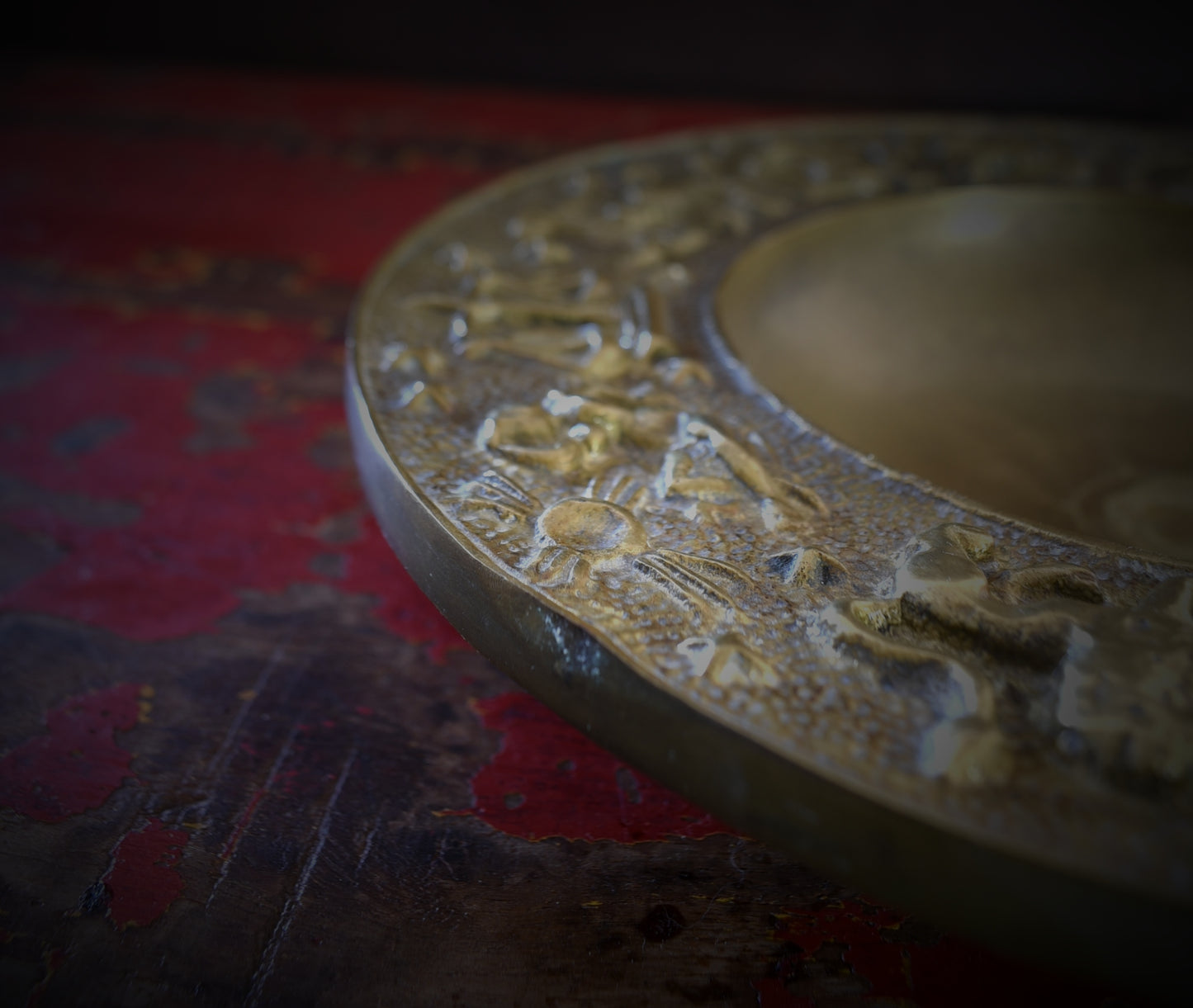
A mid-century cast-brass decorative bowl, probably dating from the 1970s. The twelve signs of the zodiac are cast in relief around the rim, Aries to Pisces circling the metal the way they circle the ecliptic. At conversational distance the zodiac reads as a band of ornament; only when the sitter is invited to look does each sign resolve.
The centre contains a circular well, approximately 5 inches across and an inch deep. This is the scrying surface. Fill it with a shallow pool of water and a few drops of black ink and the brass rim frames a mirror as dark and still as obsidian. The well is deep enough to hold a stable pool of liquid; a shallow fill keeps the surface calm and undisturbed.
Some of the photographs show the bowl filled and ready for work. The black mirror in those images is a pool of ink and water, not part of the bowl itself. Emptied, the bowl is plain brass throughout.
The bowl measures approximately 8.5 inches in diameter and weighs a shade over three pounds. The brass tarnishes honestly: the polished high points of the relief flash a bright, pale yellow, while the worn pounced ground of the background mellows to a dull greenish-grey-gold. A few light green flecks of old tarnish are visible in the sheltered recesses. It is heavy enough to hold its place on the table, light enough to pass from hand to hand. There is no maker's mark. It does not need one.
In Performance
A few drops of water-soluble black ink in a shallow pool of water, a candle beside the bowl, the room dimmed. The light catches the ink film and the brass rim holds the shadow. The bowl is old, it is heavy, and it carries the wheel of the year around its rim.
Before the bowl comes out, you know the sitter's star sign. Use whatever method you prefer to acquire it; that work is done before the bowl arrives. The bowl does not find the sign. The bowl reveals it.
You tell them what the bowl is and where bowls like it come from. Then you gaze into the ink. You take your time; whatever rises in the darkness, you let it settle before you speak. When you lift your eyes, your finger goes to the rim and stops at one of the twelve panels. This is what the surface showed you. You ask them to name the sign under your hand. They tell you. And you tell them it is theirs.
Afterwards the bowl stays on the table, reflecting nothing but the candle flame and the dark. If you have more work to do, it waits. If you do not, the bowl is its own closing.
Pairing with Hermetica
The Zodiac Scrying Bowl pairs naturally with Bobby Hasbun's Hermetica (Dark Artifice). Hermetica acquires the sitter's star sign through a concealed binary method that leaves no trace. The bowl reveals it with weight and theatre. The book is the quiet intelligence. The bowl is the public voice.
The pairing is not exclusive. The bowl works with any star-sign acquisition method you choose. But Hermetica and the bowl share a sensibility: both are old-looking objects that do more than they appear to, and both respect the sitter's intelligence.
Included
-
The Zodiac Scrying Bowl. Vintage mid-century cast-brass zodiac bowl, approximately 8.5 inches in diameter, with the twelve signs in relief around the rim and a central scrying well. A single vintage piece; the bowl photographed is the bowl you receive.
Specifications
- Diameter: approximately 8.5 inches
- Scrying well: approximately 5 inches in diameter, 1 inch deep
- Weight: approximately 3 pounds
- Material: cast brass, tarnished, with bright polished highlights on the relief
- Period: mid-century, probably 1970s
- Provenance: unattributed; no maker's mark
- Included: one brass bowl
- Ink not included. Use any water-soluble black ink.
- The black scrying surface shown in some photographs is ink and water, not part of the bowl. The bowl is sold empty and is brass throughout.